Subscribe to our newsletter
Enjoy practical advice, real talk, and notification when new resources drop.
Manage Classroom Energy Effectively
Learn effective techniques to manage classroom energy by reading the room and redirecting behavior. Discover how to stay grounded and maintain control in your classroom without losing yourself in the process.
CLASSROOM MANAGEMENT
Johnny Charles
8/30/202611 min read


The Real Classroom Question
One of the most confusing things for new teachers is this:
You can teach the exact same lesson, use the exact same slides, give the exact same directions, and bring the exact same energy.
But somehow, first period feels half-asleep.
Third period feels locked in.
Last period feels like somebody opened the gates at Six Flags and told the students, “Be free.”
Same teacher.
Same content.
Same lesson plan.
Different current.
That is because classroom energy is not frozen. It moves. It shifts. It rises. It drops. It bounces off walls, lunch tables, hallway drama, family stress, hormones, snacks, sleep, and whatever happened five minutes before they walked into your room.
The goal of classroom management is not to stop the current.
The goal is to learn how to see it, read it, and surf it.
Because if you do not learn how to surf the current, the current will drag you all the way down the hallway with your teacher badge still swinging.
Classroom Energy Is Real
Students are not robots.
They do not enter your classroom as blank slates ready to receive your perfectly aligned learning target with joy in their hearts and pencils sharpened like responsible citizens.
They walk in carrying everything.
They carry sleepiness.
They carry hunger.
They carry medication changes.
They carry social media drama.
They carry friend group tension.
They carry lunchroom conflict.
They carry excitement.
They carry embarrassment.
They carry family stress.
They carry the fact that somebody looked at them funny on the school bus.
And sometimes, one student being absent can change the whole room.
If you know, you know.
There are some students who do not just attend class. They shift the weather pattern. When they are present, the room has one energy. When they are absent, the classroom suddenly feels like a professional development commercial.
That does not mean the student is bad. It means energy is relational. Classrooms are ecosystems, and every person contributes to the climate.
Morning Energy and Afternoon Energy Are Not the Same
New teachers often blame themselves when the same lesson does not land the same way across the day. But sometimes, the lesson is not the issue.
Sometimes, the period is.
Morning Classes
Morning classes often move slower.
Students may be tired, quiet, emotionally flat, or still halfway asleep. Some stayed up late gaming, scrolling, watching videos, helping at home, or just existing in a world that does not always allow children to rest.
Some students wake up twenty minutes before school and arrive with no breakfast, no water, no energy, and no real desire to analyze a primary source document at 8:10 in the morning.
So if first period feels like you are teaching inside a library during a power outage, that may not mean your lesson is boring.
It may mean your students are still loading.
Morning energy often requires warmth, patience, structure, and a strong opening routine that wakes up the brain without shocking the system.
Afternoon Classes
Afternoon classes are different.
By the afternoon, students have eaten lunch, socialized, laughed, argued, consumed sugar, seen their friends, experienced recess, heard rumors, and possibly made three emotional decisions that they will regret by dismissal.
Now they are walking into your classroom with a full emotional playlist.
Middle school recess can be just long enough to hype students up, but not long enough to calm them back down.
So when that afternoon class walks in loud, loose, and acting like your classroom is the bonus round, understand what is happening.
The current is high.
That does not mean you surrender.
It means your structure has to meet the moment.
Last period is not just a class period. Sometimes, it is a separate country with its own laws, currency, and spiritual warfare.
Plan accordingly.
Stop Swimming Against the Current
This mindset shift changed classroom management for me:
Stop trying to overpower the energy.
You cannot beat every wave into submission. You cannot out-yell every disruption, out-stare every side conversation, or out-threaten every behavior.
That road leads to exhaustion.
And let’s be real. Many Black educators already carry the pressure of being watched differently, judged differently, and expected to manage students with authority but not too much authority, warmth but not too much familiarity, culture but not too much culture, confidence but not too much confidence.
So we have to be strategic.
Classroom management is not about proving you are in charge every five seconds.
It is about creating enough structure, awareness, and consistency that the room knows how to return to itself.
You do not have to fight the ocean.
You have to learn the waves.
Experienced Teachers Feel It Before It Happens
Have you ever watched a veteran teacher pause mid-sentence, look across the room, and stop a behavior before the student even fully commits to it?
That is not magic.
That is awareness.
Experienced teachers learn how to feel classroom energy before it becomes classroom chaos. They notice the whispers before the laughter. They notice the body language before the argument. They notice who walked in too quiet, who walked in too loud, and who is suddenly sitting near somebody they do not usually sit near.
That level of awareness takes time, but new teachers can start building it immediately.
The first step is simple.
Get out of your seat.
Step One: Get in the Hallway
If you stay behind your desk during passing period, you might hear the energy, but you will not fully feel it.
The hallway gives you information.
You can see who is upset.
You can see who is overstimulated.
You can see which friend group is moving heavy.
You can see who is avoiding eye contact.
You can see who needs a calm word before they enter.
You can see which class is already coming in hot.
Greeting students at the door is not just a cute teacher move.
It is data collection.
A calm greeting, a fist bump, a head nod, a quick “You good?” can tell you a lot. It also gives you a chance to influence the energy before it enters the classroom.
Sometimes students borrow our regulation before they find their own.
That is why your tone matters at the door.
Not fake cheerful.
Not Disney Channel teacher.
Just steady.
A steady adult can change the temperature of a room.
Step Two: Listen to Other Adults Without Joining the Drama
Experienced teachers also cross-reference with colleagues.
Not gossip.
Not “let me tell you what this child did.”
Not turning the teacher workroom into a courtroom.
Insight.
There is a difference.
A colleague might say:
“Just a heads up, they were really dysregulated after lunch.”
“Two students had conflict last period.”
“That class is unusually high today.”
“They did great with movement, but struggled when asked to work silently.”
That information can help you make proactive decisions.
Maybe you adjust the warm-up.
Maybe you move a seat before class starts.
Maybe you add a two-minute reset.
Maybe you delay group work.
Maybe you start with a calm independent task instead of opening with discussion.
The skill is learning what information is useful and what information is noise.
Do not let someone else’s frustration become your bias.
Take the information, stay professional, and let the students have a fresh start with you.
That is the balance.
Why Chaos Grows
A lot of classroom chaos grows when the teacher becomes reactive.
Students feed off emotional energy.
If the room gets loud and the adult gets louder without control, the current rises. If the adult becomes sarcastic, embarrassed, angry, or visibly shaken, the class can feel it.
That does not mean teachers are supposed to be emotionless.
We are human.
But we are the adults in the room.
That does not mean domination.
That does not mean fear.
That does not mean “because I said so” as a whole classroom management plan.
It means we model calm inside chaos.
A grounded teacher does not ignore behavior.
A grounded teacher responds with purpose.
Yelling and Raising Your Voice Are Not the Same
Let’s tell the truth.
Sometimes teachers need volume.
A classroom can get loud. A hallway can get loud. A group activity can get loud. A safety issue may require a strong voice.
But yelling and raising your voice are not the same thing.
Yelling
Yelling is reactive.
Yelling says, “I am losing control of myself because I feel like I am losing control of the room.”
It may work for a moment. Students may get quiet. But fear-based silence is not the same as classroom culture.
And eventually, students adapt.
Then you have to yell louder, more often, and with more intensity to get the same result. That cycle drains your spirit.
It also teaches students that the boundary only matters when the adult is angry.
That is not sustainable.
Raising Your Voice
Raising your voice is controlled.
It says, “We are approaching a boundary.”
It is intentional, brief, and connected to the expectation.
You are not performing anger.
You are signaling structure.
For example:
“Pause. Voices are too high. Bring it back.”
“Hold up. That side conversation is pulling us off track.”
“Reset. We are not talking over each other.”
“Freeze for a second. This energy is moving faster than our purpose.”
That is different from exploding.
Students need boundaries, but they also need to see that boundaries can be enforced without emotional chaos.
That is how classroom culture grows.
Be Careful With Empty Threats
Middle school students are professional boundary testers.
They will find the weak spot in your system like they work for quality control.
If you threaten consequences and do not follow through, students will eventually learn that your words are decoration.
That does not mean you need to be harsh.
It means you need to be clear.
Consequences should be:
Intentional.
Consistent.
Connected to the behavior.
Individual when possible.
Calmly delivered.
Group punishments often create resistance because students can hide inside the crowd. The students doing the right thing become frustrated, and the students causing the issue get to disappear inside the whole class consequence.
Private accountability usually works better.
Pull the student when the audience is gone. Address the pattern. Name the behavior. Give the expectation. Assign the consequence if needed. Then move forward.
No speech.
No public trial.
No dramatic courtroom scene.
This is not “Law & Order: Middle School Unit.”
Handle it and keep teaching.
Do Not Stop the Whole Lesson for Every Disruption
One of the strongest classroom management skills is knowing how to pause without derailing the lesson.
Think about a comedian handling a heckler.
A skilled comedian does not stop the entire show for every comment from the crowd. They pause, address it quickly, regain the room, and keep going.
Teachers need that same rhythm.
Pause.
Redirect.
Keep teaching.
Not every behavior deserves a full public conversation.
Sometimes a look is enough.
Sometimes proximity is enough.
Sometimes a name and a pause is enough.
Sometimes a quick reset is enough.
If a student is seeking attention, do not turn the behavior into a stage play.
You can address the deeper issue later during work time, passing period, lunch detention, or a one-on-one check-in.
The goal is to protect the learning environment without feeding the disruption.
That takes practice.
Why Teachers Leave Drained
A lot of teachers are emotionally exhausted because they spend the entire day reacting.
Reacting to every noise.
Reacting to every side conversation.
Reacting to every facial expression.
Reacting to every pencil sharpener trip.
Reacting to every “bruh.”
Reacting to every student who suddenly needs tissue, trash, water, the bathroom, and spiritual guidance during direct instruction.
That level of reaction will wear you out.
Students often have more energy than adults. And teachers are outnumbered.
Trying to emotionally battle every off-task behavior in real time will pull you into power struggles you never needed to enter.
Every behavior does not need your immediate emotion.
Some behaviors need documentation.
Some need proximity.
Some need a private conversation.
Some need a consequence.
Some need a relationship check.
Some need to be ignored strategically for the moment and addressed later.
That is not weakness.
That is wisdom.
A Practical Strategy: Delay the Reaction
One of the most powerful classroom management strategies is creating space between what happens and how you respond.
That space protects your peace.
Instead of reacting emotionally in the moment, try this:
Observe.
Document.
Keep teaching.
Look for patterns.
Address it later.
A simple spiral notebook can change your life.
Keep it near you while you teach. When a behavior happens, jot down the student’s name, the behavior, and the time.
Do not stop the whole class unless you need to.
Keep your instruction moving.
Later, during independent work, passing period, lunch detention, or a private check-in, address the pattern.
You might say:
“I noticed you interrupted directions three times today. What was going on?”
“I saw you kept turning around during the lesson. I need you facing forward during direct instruction.”
“You were feeding off the group energy today. Tomorrow, I need you to help settle the room, not stir it.”
That kind of conversation is calmer, clearer, and more effective because you are not speaking from the heat of the moment.
You are responding from evidence.
That is professional.
That is sustainable.
That is how you keep your peace without letting behavior slide.
Reflection for New Teachers
Ask yourself:
Which class period has the calmest energy? Why?
Which class period has the highest energy? What happens before they come to you?
Do you know what your students are carrying into the room?
Are you greeting students in a way that gives you information?
Do you react to behavior immediately because it needs an immediate response, or because it triggers you?
Are your consequences clear, consistent, and connected to the behavior?
Are you trying to control every wave, or are you learning how to surf the current?
These questions are not about shame.
They are about awareness.
Classroom management is reflective work.
And for Black educators, that reflection matters even more because our presence, tone, authority, and authenticity are often misread through other people’s assumptions.
That is why we cannot afford to only be reactive.
We have to be strategic, grounded, and clear about who we are.
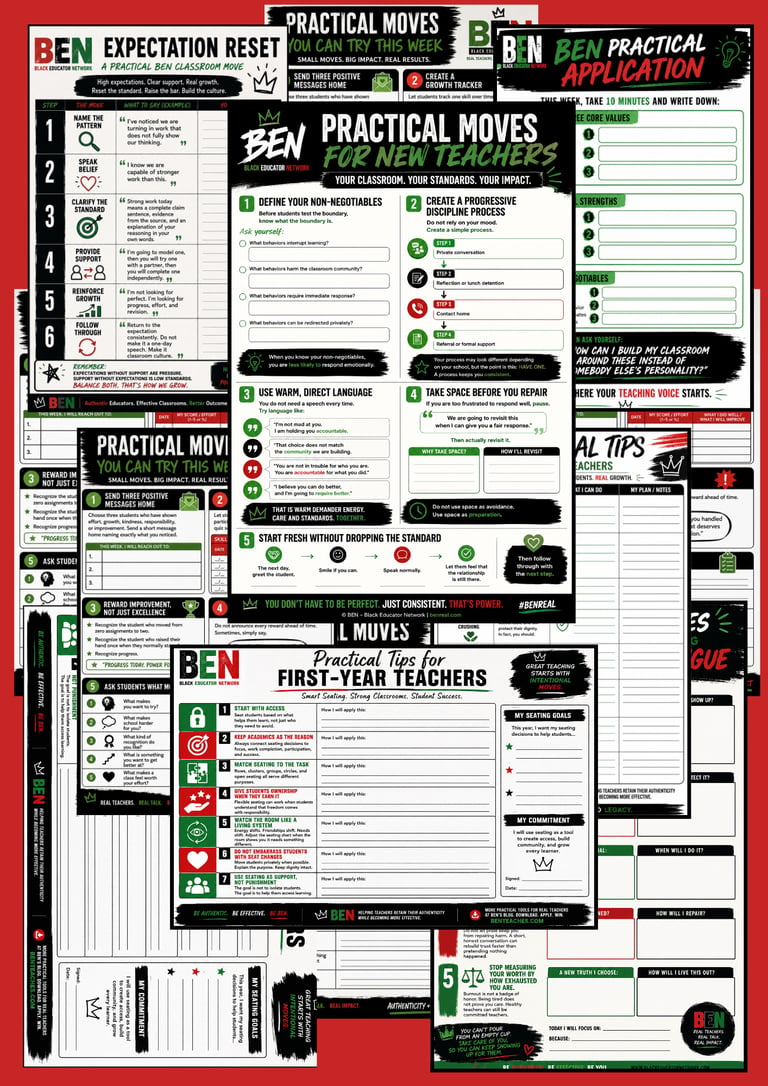
Practical Tips for First-Year Teachers
1. Watch energy patterns.
Every class period has its own current. Stop expecting every period to feel the same.
2. Get into the hallway.
The hallway tells you what kind of energy is coming before it crosses your doorway.
3. Greet students with calm confidence.
Your regulation can influence their regulation.
4. Do not perform for the audience.
Avoid power struggles that turn one student’s behavior into a whole class event.
5. Pause before you explode.
A brief pause and clear redirection is stronger than emotional escalation.
6. Address patterns later.
Everything does not need an immediate public reaction.
7. Follow through calmly.
If you name a consequence, be prepared to apply it.
8. Protect the lesson.
Do not let every disruption pull you away from instruction.
9. Use private accountability.
Students often respond better when they are corrected without an audience.
10. Give yourself grace.
You are learning how to read the room, ride the waves, and stay grounded at the same time.
The BEN Takeaway
Teaching is emotional work.
Every day, you stand inside the emotional currents of young people who are still learning how to manage themselves.
Some days the current is calm.
Some days it crashes.
Some days it pulls hard against you.
But your job is not to stop every wave.
Your job is to see the wave early, stay grounded, adjust your position, and ride it without losing yourself.
That is classroom management.
That is teacher growth.
That is the work.
And around here, we do the work without giving up our voice, our culture, or our peace.
Keep teaching.
Keep reflecting.
Keep it real.