
Subscribe to our newsletter
Enjoy practical advice, real talk, and notification when new products/articles drop.
Stop Lowering the Bar: How to Set Expectations Students Can Actually Rise To
Students do not rise just because we say "high expectations." They rise when belief, support, culture, and classroom systems line up. In this post, I help new teachers set expectations that are firm, fair, culturally responsive, and rooted in growth.
CLASSROOM MANAGEMENT
Johnny Charles
6/16/202612 min read


Every teacher knows this feeling.
You look around the room and think:
“Y’all are smarter than this.”
Not in a shady way. Not in a judgmental way. In that deep teacher-spirit kind of way where you can see the greatness in students before they can see it in themselves.
You know they can write more than two sentences.
You know they can think deeper than “IDK.”
You know they can participate without acting like raising their hand costs money.
You know they can do more than the bare minimum.
But still, the work comes back half-done. The answers are shallow. The energy is low. The effort is inconsistent.
So the question becomes:
Are my students doing the minimum because they are incapable, or because my expectations have not been clearly taught, modeled, supported, and believed?
That question matters.
Because expectations are not just what we demand from students. Expectations are what students experience from us every day.
They hear it in our words.
They feel it in our tone.
They see it in our body language.
They test it in our consistency.
They believe it when our support matches our standard.
So let’s talk about low, high, and lofty expectations — and how to set the kind of bar that helps students actually rise.
Why Students Sometimes Do the Minimum
Before we blame laziness, attitude, phones, home life, TikTok, or “kids these days,” we have to pause and ask a hard teacher question:
What am I communicating to students about what I believe they can do?
And I do mean communicating in every way.
Not just what you say during the inspirational speech on Monday morning. I mean what your whole classroom presence communicates - even on a Friday afternoon.
Students are always reading us.
They read our face when they ask a question.
They read our tone when we redirect them.
They read our patience when they struggle.
They read our urgency when they turn in late work.
They read whether we actually expect them to revise or if we are just tired and ready to move on.
Especially as Black educators, many of us know what it feels like to be underestimated, overcorrected, mislabeled, or expected to shrink. We know what it feels like when somebody says they believe in you but their actions say, “I already decided who you are.”
That is why our expectation work has to be clean.
Students need to know:
“I see you. I believe in you. I am not scared of your potential. And I am not going to let you hide from it either.”
That is the sweet spot.
Say the Belief Clearly
Some students have not heard enough adults speak belief over them in plain language.
They do not need sarcasm.
They do not need coded language.
They do not need “you know better” with no pathway forward.
They do not need public embarrassment dressed up as accountability.
Sometimes they need to hear it straight:
“You are capable of more than this.”
“I believe you can do this.”
“This is not your best work, and I care too much to accept less.”
“We are going to fix it together.”
That kind of language is both firm and loving.
It does not lower the standard.
It does not attack the student.
It separates the student’s identity from the student’s current performance.
That matters because a lot of students already walk into school carrying labels.
Lazy.
Defiant.
Low.
Behind.
Too much.
Not enough.
Your classroom has to interrupt those labels.
High expectations begin when students understand that their current performance is not the final word on their ability.
Check Your Nonverbal Messages
Now here is where it gets real.
You might believe in students internally, but if your body language communicates irritation, disbelief, or defeat, students will believe what they see before they believe what you say.
Your nonverbal communication includes:
Your facial expressions
Your tone
Your posture
Your proximity
Your silence
Your urgency
Your consistency
Your follow-through
A student can tell when a teacher has already given up on them.
They can also tell when a teacher is frustrated but still invested.
There is a difference.
The former says, “You are getting on my nerves, and I am done with you.”
The latter says, “This behavior is not okay, but I am still here, and I still expect better from you.”
That second message is powerful.
That is warm demander energy.
You can be warm without being soft.
You can be firm without being cruel.
You can hold students accountable without trying to humiliate them.
The goal is not to perform toughness. The goal is to build trust strong enough that correction can actually land.
Check Your Beliefs Before You Check Their Effort
Before we talk about student effort, we have to talk about teacher belief.
Ask yourself:
Do I truly believe my students can grow?
Do I believe that because I have seen it, or because I heard it in a training?
Do I believe all students can grow, or only the students who make my job easier?
Do I believe in growth when students are quiet, compliant, and polite, but struggle to believe it when students are loud, guarded, or resistant?
That reflection is uncomfortable, but necessary.
Some beliefs are ours.
Some beliefs were handed to us.
Some beliefs came from our own schooling.
Some beliefs came from teacher lounges, collaborative meetings, deficit language, or survival mode.
As Black teachers, we often carry a double awareness. We know the system can misread our students, and we also know we have to prepare our students to navigate a world that may not give them endless grace.
So our expectations must be rooted in love and reality.
Not pity.
Not savior energy.
Not fear.
Not control.
Love and reality.
Love says, “You are worthy right now.”
Reality says, “And you still need the skills.”
Love says, “Your story matters.”
Reality says, “Your work has to communicate clearly.”
Love says, “I see your brilliance.”
Reality says, “Now let’s build the discipline to express it.”
That is the balance.
Do Not Just Tell Students They Are Capable. Show Them.
There are levels to expectations.
Level one: You say students are capable.
Level two: You believe students are capable.
Level three: You design experiences that prove students are capable.
That third level is where real teaching begins.
Students need evidence of their own ability.
Not just a motivational quote on the wall.
Not just a “you got this” before the test.
Not just a speech after grades are already low.
They need classroom moments where they struggle, receive support, try again, and succeed.
That means we have to design work that pushes them without abandoning them.
High expectations require support.
Support can look like:
Sentence stems
Models and examples
Small-group reteaching
Graphic organizers
Chunked assignments
Think time
Peer discussion
Revision opportunities
Clear rubrics
Conferencing
Practice before grading
Feedback students can actually use
When students experience success after struggle, something shifts.
They start to think:
“Maybe I can do this.”
And once a student starts believing that, you have something to build on.
Low Expectations, High Expectations, and Lofty Expectations
Let’s define the difference.
Low Expectations
Low expectations happen when students are not challenged.
This might sound like:
“They can’t handle that.”
“They will never do it.”
“At least they turned something in.”
“I’m just trying to get through the day.”
“These kids don’t care.”
Low expectations often come from exhaustion, frustration, or fear of conflict. Sometimes teachers lower the bar because they are trying to be kind. But low expectations do not protect students. They limit students.
When we expect too little, students grow too little.
High Expectations
High expectations push students toward growth while providing the support they need to get there.
High expectations sound like:
“This is challenging, but we are going to break it down.”
“You may not have it yet, but you can build it.”
“I will support you, but I will not do the thinking for you.”
“This needs revision because your voice deserves clarity.”
“We are not stopping at almost.”
High expectations are reachable with effort, instruction, feedback, and support.
That is the key.
Lofty Expectations
Lofty expectations sound good, but they are not realistic.
Lofty expectations ask students to perform at a level they have not been prepared for, with tools they do not have, under conditions that do not support success.
That might look like assigning a five-paragraph essay without teaching paragraph structure.
Expecting independence from students who have not practiced independent routines.
Demanding grade-level performance without addressing missing skills.
Giving a major project with unclear directions and then calling students lazy when they are lost.
Lofty expectations can disguise themselves as rigor.
But rigor without support is just struggle.
And struggle without support becomes shutdown.
The difference is simple:
High expectations are reachable with support. Lofty expectations are unreachable even with support.
How to Set High Expectations Without Becoming “Too Strict”
Here is the truth every new teacher needs to hear:
Some students will think you are strict.
Some families may think you are strict.
Some coworkers may think you are strict.
Some people may think you are not strict enough.
You cannot build your whole classroom around everybody’s perception.
Instead, focus on your practice.
Ask yourself:
Are my expectations clear?
Are they consistent?
Are they fair?
Are they connected to learning and growth?
Do students understand why the expectation matters?
Do I provide support before I provide consequences?
Am I correcting behavior without attacking identity?
That is the work.
Being strict is not the problem. Being unclear, inconsistent, reactive, or power-hungry is the problem.
A strong classroom does not require you to become somebody else. It requires you to become consistent your best version with purpose.
Start With Equality, Then Respond to Reality Equitably
At the beginning, start students with the same belief:
Everybody in this room is capable of growth. Everybody in this room will be expected to think, participate, revise, and improve.
That is the baseline.
But equity does not mean every student gets the exact same support.
Equity means we pay attention.
Observe what students can do.
Listen to what they need.
Notice where they struggle.
Look for patterns.
Adjust the support.
Some students need more modeling.
Some need more time.
Some need smaller steps.
Some need more challenge.
Some need a relationship before the instruction can fully land.
Some need quiet encouragement.
Some need you to stop letting them charm their way out of work.
Responsive expectations are not lowered expectations.
You are not watering down the goal. You are building a bridge to it.
Shift From Perfection to Growth
One of the biggest traps in education is overvaluing perfection.
Perfect behavior.
Perfect essays.
Perfect data.
Perfect lesson plans.
Perfect teacher voice.
Perfect classroom aesthetic.
But perfection is not where learning lives.
Growth lives in the reps.
Think about anything excellent: music, athletics, cooking, public speaking, teaching, preaching, braiding hair, building a business, writing, anything.
The polished performance came from messy practice.
So why do we act shocked when students are messy during the learning process?
If you expect perfection, students may shut down.
They will avoid risk.
They will copy.
They will say “I don’t know” before trying.
They will turn in nothing instead of turning in something imperfect.
They will protect their pride instead of building their skill.
But when you value growth, students have room to try.
That does not mean anything goes. It means mistakes become information.
The question becomes:
What does this mistake tell us we need to practice next?
That shift can change the energy in your classroom.
Fear of Failure Is Often Hiding Behind “I Don’t Care”
A lot of students do not avoid work because they do not care.
They avoid work because they care enough to be embarrassed by failure.
“I don’t care” is sometimes armor.
It protects them from saying:
“I do not understand.”
“I am behind.”
“I am scared I will look dumb.”
“I have failed before.”
“I do not want people to see me try and still not get it.”
So instead of only pushing the outcome, teach students how to survive the process.
Say things like:
“Getting stuck is part of learning.”
“Wrong answers help us locate the next step.”
“Your first draft is not your final identity.”
“We are practicing, not performing.”
“Progress counts.”
That language lowers the fear without lowering the expectation.
Use Chunking to Build Confidence
Some students need momentum before they believe in themselves.
That is where chunking comes in.
Break big tasks into smaller wins:
One paragraph at a time
One question at a time
One section at a time
One daily goal
One weekly checkpoint
One revision focus
One skill at a time
Think of it like money.
Some people are motivated by one big paycheck. Other people need smaller deposits along the way to stay encouraged.
Students are similar.
A big final goal can feel too far away. But a small win today can build the confidence to try again tomorrow.
Small wins build confidence.
Confidence builds persistence.
Persistence builds growth.
And growth is the whole point.
What If Students Are Far Below Grade Level?
This is where new teachers often panic.
You give the assignment. You realize some students are missing major foundational skills. Now you are stuck between the grade-level standard and the reality in front of you.
Start here:
1. Begin With the Same Goal
Do not decide from day one that certain students are not capable of meaningful work.
Give everyone access to the goal.
2. Identify the Gaps
Figure out what is actually missing.
Is it vocabulary?
Reading stamina?
Background knowledge?
Writing structure?
Confidence?
Executive functioning?
Language support?
Task clarity?
Do not just say, “They can’t do it.”
Find the gap.
3. Build the Bridge
Once you know the gap, add support.
Model it.
Chunk it.
Practice it.
Provide tools.
Give feedback.
Let students revise.
Celebrate progress.
You are not lowering expectations. You are making the path visible.
That is teaching.
What If Students Still Do Not Meet Expectations?
Now we troubleshoot.
Not shame.
Not panic.
Not “these kids just won’t.”
Troubleshoot.
Check the Relationship
Ask:
Do students believe I care about them?
Have I built enough trust for correction to land?
Is there unresolved tension between me and this student?
Am I only interacting with them when something is wrong?
Students do not have to like every assignment, but many will work harder for teachers they believe care about them.
Relationship does not replace expectations. Relationship gives expectations somewhere to land.
Check the Communication
Ask:
Have I clearly explained the expectation?
Have I modeled what success looks like?
Have I shown examples and non-examples?
Have I said out loud that I believe they can improve?
Do my actions match my words?
Sometimes we think we taught the expectation because we announced it.
But announcing is not teaching.
Teach the expectation like you would teach content.
Check the System
Ask:
Is the task realistic?
Is the timing reasonable?
Are the directions clear?
Do students have the materials?
Are supports in place?
Have I created too many distractions in the room?
Is the routine strong enough to support the expectation?
Sometimes the issue is not student motivation. Sometimes the system is leaky.
Fix the system before you label the student.
Check the Motivation
Do not try to install motivation like software.
Find it.
Every student is motivated by something:
Recognition
Belonging
Competition
Creativity
Independence
Leadership
Success
Relationships
Purpose
Movement
Choice
Curiosity
Your job is not to decide what should motivate them. Your job is to discover what already does and connect it to growth.
And if they do not know yet, help them explore.
A Practical BEN Classroom Move
Try this expectation reset with your class:
Step 1: Name the Pattern
“I’ve noticed we are turning in work that does not fully show our thinking.”
Step 2: Speak Belief
“I know we are capable of stronger work than this.”
Step 3: Clarify the Standard
“Strong work today means a complete claim sentence, evidence from the source, and an explanation of your reasoning in your own words.”
Step 4: Provide Support
“I’m going to model one, then you will try one with a partner, then you will complete one independently.”
Step 5: Reinforce Growth
“I’m not looking for perfect. I’m looking for progress, effort, and revision.”
Step 6: Follow Through
Return to the expectation consistently. Do not make it a one-day speech. Make it classroom culture.
Reflection Questions for New Teachers
Use these questions before your next lesson, especially if students are not meeting expectations:
What expectation am I asking students to meet?
Have I taught that expectation clearly?
Have I modeled what success looks like?
What support do students need to reach the expectation?
Am I expecting growth or perfection?
What might students be afraid of?
Does my tone communicate belief or frustration?
Am I being firm with purpose or strict from irritation?
What small win can I build into the lesson?
How will I celebrate progress without lowering the bar?
Final Thought: The Bar Needs a Bridge
Expectations are not just what we demand.
Expectations are what we communicate, model, support, and make possible.
Low expectations deny students the chance to grow.
Lofty expectations demand performance without preparation.
High expectations build a bridge between where students are and where they can go.
That bridge is made of belief, clarity, structure, support, feedback, relationship, and repetition.
So yes, set the bar high.
But do not just stand at the top yelling, “Come on.”
Build the steps.
Teach the climb.
Walk with them through the struggle.
Celebrate the progress.
Then remind them who they are becoming.
Because when expectations are set right, students do not just meet the bar.
They learn how to rise.
Explore our products & Services
Provide a short description of categories listed below.
Free Download
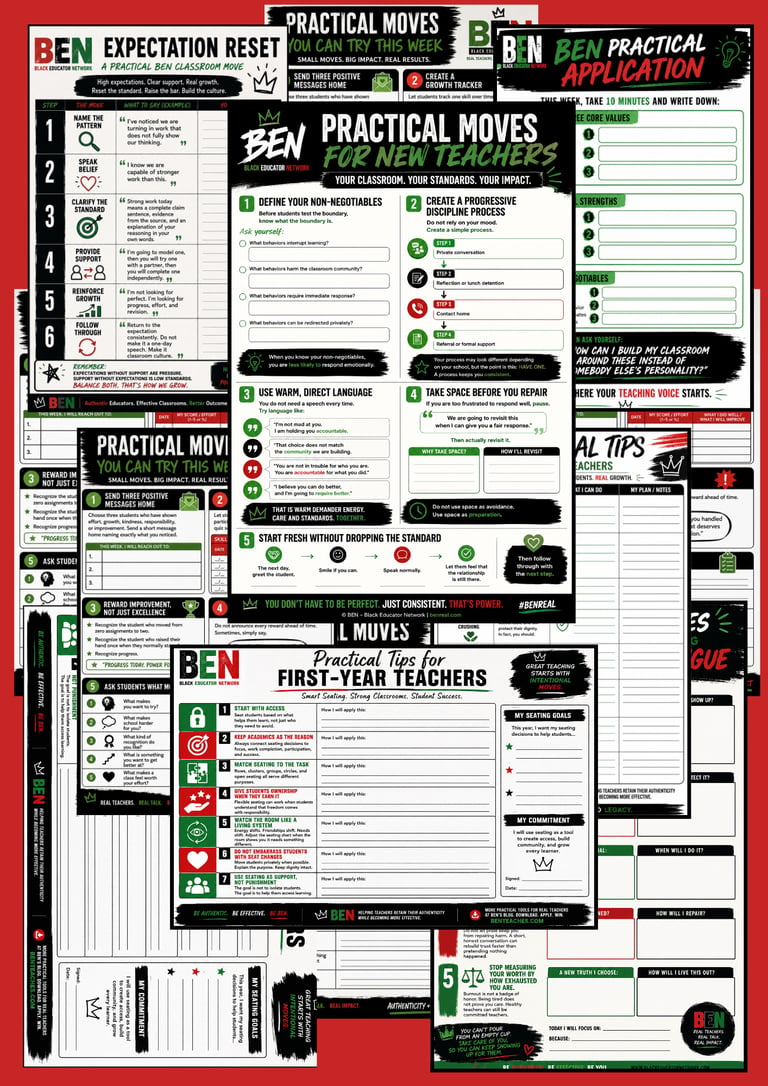




Grab your free Expectation Reset intentional planner one pager.
Sub Plans
Purchase ready to go and easy to follow sub plans that build independent thinkers.
BEN Gear
Represent the culture by wearing BEN gear.