Subscribe to our newsletter
Enjoy practical advice, real talk, and notification when new products/articles drop.
Stop Code-Switching Your Teaching
Too many new teachers spend their first year trying to become the teacher they think students, administrators, or coworkers want. In this reflection, I explore why authenticity is one of the most underrated classroom management strategies-and how black educators can lead with confidence without abandoning who we are.
TEACHER MINDSET
Johnny Charles
6/17/20265 min read


Let's keep it real.
One of the most exhausting parts of being a new teacher isn't lesson planning.
It isn't grading.
It isn't even classroom management.
It's the pressure to perform.
The pressure to sound different.
Act different.
Dress different.
Talk different.
The pressure to become some version of "professional" that feels nothing like the person who showed up to the interview.
For many Black educators, that pressure starts long before the first day in our school buildings.
We've spent years navigating spaces where authenticity came with consequences.
Too Black.
Too loud.
Too passionate.
Too direct.
Too urban.
Too cultural.
Too much.
Then we enter education and receive another unspoken message:
"Be yourself...but not that much."
So many first-year teachers start their careers trying to build a classroom with somebody else's personality.
They copy the strict teacher.
They imitate the loud teacher.
They rehearse phrases that don't sound natural.
They try to become a character instead of becoming a teacher.
And eventually they discover something important:
Pretending is exhausting.
Students Can Smell Fake from a Mile Away
I teach Middle schoolers and can say that they deserve an award for this.
They can spot inauthenticity before you finish taking attendance.
They know when you're forcing it.
They know when you're trying too hard.
They know when you're borrowing somebody else's style.
Students spend all day reading people.
They notice body language.
They notice tone.
They notice energy.
And when your classroom persona doesn't match who you really are, students often feel it before you do.
That disconnect creates friction.
Not because students need you to be perfect.
But because students need you to be real.
You Don't Need More Personality
You Need More Clarity
One of the biggest myths in education is that classroom management comes from charisma.
It doesn't.
We've all seen teachers who can command a room with a whisper.
And we've all seen teachers who yell all day and still can't get students focused.
Students don't need volume.
They need clarity.
They need consistency.
They need to know:
What matters here?
What are the expectations?
What happens when I meet them?
What happens when I don't?
How does this teacher treat people?
The teacher who answers those questions consistently will usually outperform the teacher who's simply the loudest.
Black Teachers Face a Different Version of This Conversation
Let's say the quiet part out loud.
Many Black educators spend our careers balancing authenticity and acceptance.
We're often encouraged to build relationships.
But not too much.
Bring culture into the classroom.
But not too much.
Show personality.
But not too much.
Be passionate.
But not too much.
At some point, new teachers have to decide:
Am I building a classroom around fear or around purpose?
Because the moment you start teaching from fear, you begin shrinking.
And a shrinking teacher rarely creates an expanding classroom.
Your students deserve the full strength of your gifts.
Not a watered-down version.
Not a corporate version.
Not a survival version.
The best version.
Know Thyself Before You Teach Anybody Else
Before you worry about classroom management, learn yourself.
Ask:
What kind of energy do I naturally bring into a room?
How do I handle conflict?
What frustrates me?
What inspires me?
What are my non-negotiables?
What kind of classroom feels healthy to me?
Some teachers are naturally warm.
Some are naturally structured.
Some lead with humor.
Some lead with calm.
Some lead with storytelling.
Some lead with precision.
None of those are wrong.
The goal isn't to become another teacher.
The goal is to become the strongest version of yourself.
Warm Doesn't Mean Weak
Let's retire this myth immediately.
A lot of new teachers believe they have to be hard to earn respect.
That's not true.
Students do not confuse kindness with weakness.
They confuse inconsistency with weakness.
There's a difference.
You can smile and still hold students accountable.
You can care deeply and still write referrals.
You can listen and still say no.
You can build relationships and still maintain boundaries.
In fact, some of the strongest teachers I've ever encountered were warm demanders.
Teachers who communicate:
"I care about you too much to lower the standard."
That's not weakness.
That's leadership.
Adaptation Is Not Selling Out
Now let's be clear.
Authenticity doesn't mean behaving the same way in every situation.
Strong teachers have range.
You may be more formal during an observation.
More structured during testing.
More energetic during instruction.
More reflective during restorative conversations.
That isn't fake.
That's professionalism.
Think of authenticity like home.
You can travel all over the place.
But eventually you return home.
Your values remain the same.
Your core remains the same.
Your purpose remains the same.
Stop Comparing Your Chapter One to Somebody Else's Chapter Twenty
Comparison has probably stolen more confidence from new teachers than student behavior ever could.
You watch a veteran teacher work magic.
You see a teammate run a flawless lesson.
You observe someone who seems born for this work.
And suddenly you're questioning yourself.
Don't do that.
Study great teachers.
Borrow strategies.
Adapt systems.
Learn techniques.
But don't steal identities.
Ask:
How can I make this fit me?
That's where growth happens.
Not imitation.
Adaptation.
Why Authenticity Improves Classroom Management
Students thrive when adults are predictable.
Not boring.
Predictable.
They need to know:
Who is this person?
What do they stand for?
How do they treat people?
What happens when mistakes occur?
Authentic teachers answer those questions naturally.
Students know where they stand.
And when students know where they stand, they often feel safer.
When students feel safer, behavior improves.
Trust grows.
Learning increases.
Authenticity isn't just about identity.
It's about stability.
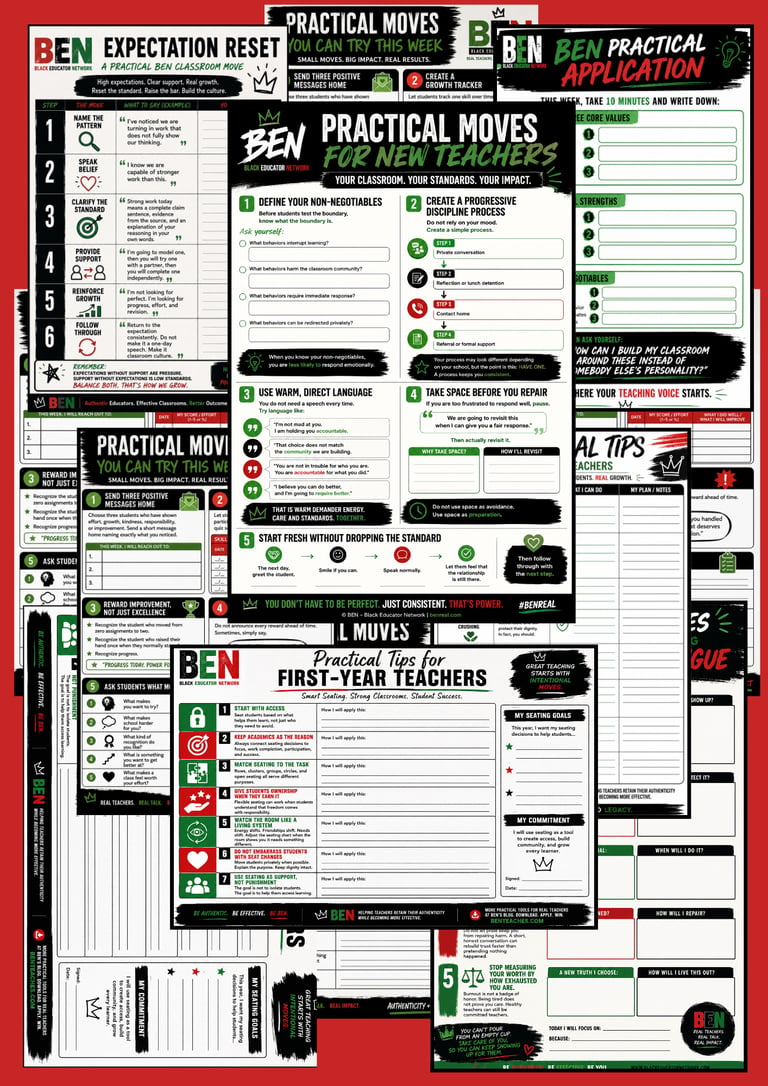
BEN Practical Application
This Week, Take 10 Minutes and Write Down:
My Top Three Core Values
Examples:
Respect
Growth
Excellence
Curiosity
Accountability
Community
My Natural Strengths
Examples:
Humor
Calmness
Creativity
Empathy
Organization
Storytelling
My Non-Negotiables
Examples:
No disrespect
No bullying behavior
Everyone participates
Everyone belongs
Then ask yourself:
"How can I build my classroom around these instead of somebody else's personality?"
That's where your teaching voice starts.
Final Thought
You don't need to become the loudest teacher.
You don't need to become the toughest teacher.
You don't need to become somebody else.
The profession already has that person.
What it doesn't have is you.
And trust me—
Your students can tell the difference.
Keep your voice.
Build your craft.
Teach from a place that's real.
Because the strongest classroom management strategy isn't pretending to be somebody else.
It's being somebody worth trusting.