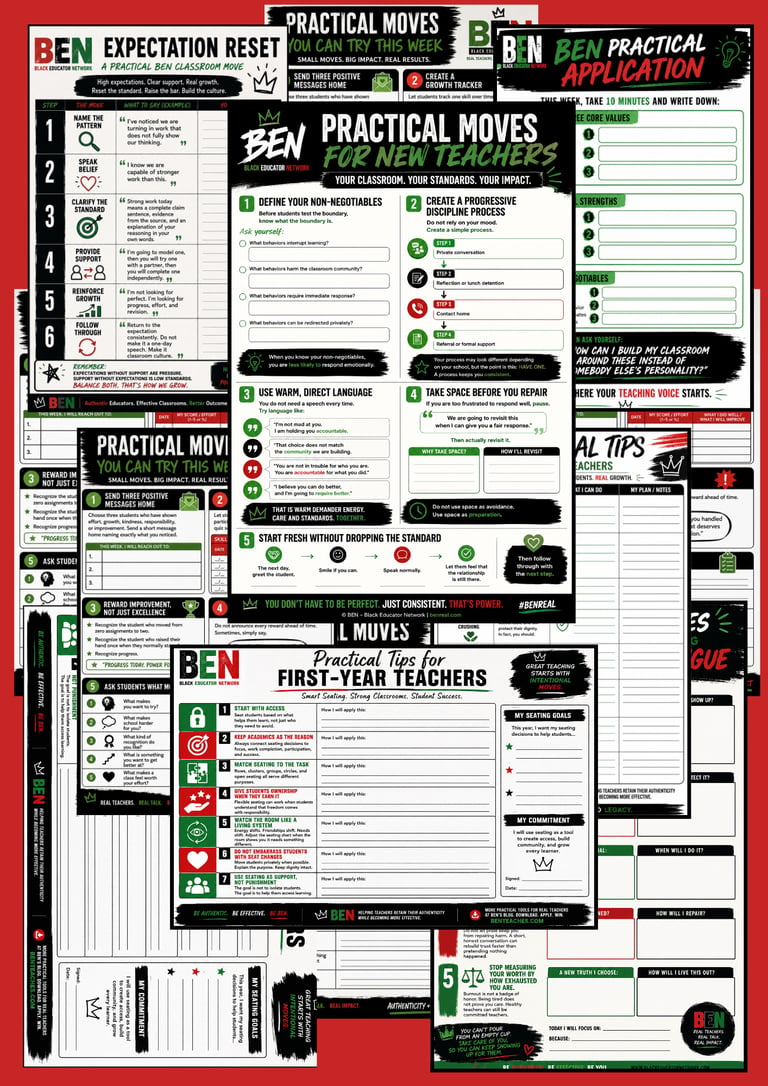
Subscribe to our newsletter
Enjoy practical advice, real talk, and notification when new resources drop.
Rapport Ain't Fake: How to Build Real Relationships Without Performing for Students
New teachers hear "build relationships" all the time, but nobody explains how to do it without being awkward, fake, or too friendly. Let's break down how curiosity, consistency, and boundaries help teachers connect with students while still leading the classroom.
CULTURE BUILDING
Johnny Charles
6/19/20268 min read
One of the biggest myths in education is that classroom management starts with rules.
It does not.
Rules matter. Procedures matter. Consequences matter. Structure definitely matters.
But before a student respects your redirection, they usually need to know there is a real person behind it.
Classroom management starts with relationship.
And relationship starts with curiosity.
Not fake curiosity.
Not “I read this strategy in a teacher book, so now I’m going to ask you three questions before I redirect you” curiosity.
Not performative hallway-energy curiosity.
Real curiosity.
The kind that says, “I see you as a whole person, not just a behavior I need to manage.”
That matters.
Especially for Black educators and new teachers who are trying to build classrooms where students feel seen, challenged, protected, and pushed. You are not trying to be their friend. You are not trying to be the cool teacher. You are not auditioning for approval.
You are building trust.
Because trust makes the work possible.
What Does It Mean to “Be Curious”?
Being curious means you are willing to learn your students before you try to lead them.
That does not mean students get to run the room. That does not mean you lower expectations. That does not mean you let disrespect slide because you want them to like you.
It means you take time to understand who is sitting in front of you.
Because students can feel intention.
They know when an adult is asking questions just to check a box. They know when someone is pretending to care. They know when a conversation is really about control. They know when the “relationship-building” is just a setup for correction.
So before you ask a student something, check yourself first.
Ask:
Why am I asking this?
Am I asking to understand them?
Am I asking to connect?
Am I asking because I genuinely want to know?
Or am I asking because I want quick access to compliance?
That difference matters.
Real curiosity sounds simple:
“How was your weekend?”
“What are you into right now?”
“How did your game go?”
“What music have you been listening to?”
“What’s been the best part of your day so far?”
“What do you wish teachers understood about students your age?”
Then comes the part some adults struggle with.
Listen.
Do not turn every answer into a lecture.
Do not make every story about you.
Do not rush to give advice.
Do not use their answer against them later.
Sometimes the most powerful thing you can do is hear a student and let their words stand.
That is how you communicate, “You matter even when I am not correcting you.”
Rapport Is Built in Small Moments
New teachers often think relationship-building has to be big.
A whole community circle.
A full class activity.
A major emotional breakthrough.
A movie-scene moment where a student finally says, “You changed my life, Mr. Charles.”
Now listen.
Those moments are beautiful when they happen. But most rapport is not built like that.
Rapport is built in small, repeated moments.
It is the greeting at the door.
It is remembering a student’s preferred name.
It is noticing the haircut.
It is asking about the game.
It is saying, “I’m glad you made it today.”
It is checking in after a rough class without embarrassing them.
It is seeing them at the concert, the game, the debate, the performance, the cafeteria, the hallway, the community event.
It is the fist bump.
The head nod.
The “You good?”
The “I saw you working today.”
The “I know yesterday was rough, but we back at it today.”
You do not have to do everything.
But you do have to be consistent.
The key is not doing a lot one time.
The key is doing a little often.
Students trust patterns more than speeches.
They are watching to see if your care has stamina.
But What About Students Who Are Closed Off?
Every teacher will meet students who seem distant.
Some students will not smile back.
Some will shrug at every question.
Some will act like your kindness is suspicious.
Some will test you before they trust you.
Do not take it personally.
That student may have learned that adults are temporary. That promises are cheap. That attention only comes when they are in trouble. That being vulnerable is unsafe. That school is a place where they are judged before they are understood.
So when you show up with genuine care, they may not know what to do with it yet.
Keep showing up anyway. But do not chase.
There is a difference between being consistent and begging for connection.
You can care without forcing closeness.
You can offer warmth without demanding a response.
You can hold a boundary without taking their resistance as disrespect.
Sometimes a student needs to see that you will be steady even when they are guarded.
That is the work. Not soft. Not weak. Not passive.
That is disciplined love.
That is grown-up energy.
That is teacher leadership.
How Rapport Helps Classroom Management
Let’s keep it real.
Some people talk about relationships like they are separate from classroom management.
They are not.
Relationships are part of management.
When students know you see them, they are more likely to hear you when you correct them.
When students believe you respect them, redirection does not always feel like attack.
When students trust your intentions, they are more willing to reset.
That does not mean rapport magically fixes every behavior.
It will not.
Some students will still challenge you and some days will still be difficult. Some classes will still test every ounce of patience you packed in your teacher bag.
But rapport gives you something to stand on.
Without relationship, correction can sound like control.
With relationship, correction can sound like guidance.
That difference can change the whole room.
A student who knows you care may still roll their eyes, but they are more likely to come back later and say, “My bad.”
A student who trusts you may still have a bad day, but they are more likely to let you help them recover.
A student who feels seen may still need consequences, but they are less likely to believe you are out to get them.
That is why curiosity matters.
You are not just collecting fun facts.
You are building a bridge strong enough to carry correction, accountability, and growth.
Friendship Is Not the Goal
Now let’s be clear.
Building rapport does not mean becoming your students’ friend.
Students do not need another peer.
They need a caring adult.
They need mentorship.
They need structure.
They need honesty.
They need boundaries.
They need somebody who can laugh with them and still say, “No, we are not doing that.”
They need somebody who can appreciate their personality and still hold them accountable.
They need somebody who can understand their story without lowering the standard.
That is where many new teachers get stuck.
They think the choices are either:
Be strict and disconnected or be liked and lose control.
That is a false choice.
You can be warm and firm.
You can be culturally connected and professionally grounded.
You can be funny and still serious.
You can be kind and still have consequences.
You can be authentic and still be the adult in the room.
Connection with boundaries wins - every time.
Questions That Actually Help Build Connection
A lot of new teachers feel awkward when they try to talk to students.
That is normal.
You are learning them while they are learning you.
Do not force deep conversations too early. Relationships are slow-cooked, not microwaved.
Start simple.
Try questions like:
“What do you like to do after school?”
“What kind of music are you into?”
“What’s been the best part of your week?”
“What class do you enjoy most right now?”
“What helps you have a good day at school?”
“What’s something teachers do that makes class harder than it needs to be?” (students love venting)
“What is something you wish adults understood about students?”
“What are you proud of right now?”
Some students will give you full paragraphs.
Some will give you two words.
Some will say, “I don’t know.”
That is fine.
Do not panic.
Do not overperform.
Do not turn into a game show host. Just keep the door open.
Sometimes the first conversation is not the breakthrough.
Sometimes the first conversation is just proof that you are safe enough for a second one.
Practical Moves for New Teachers
Here are five simple ways to build rapport without being fake.
1. Learn Names Correctly
First name. Last name. Preferred name. Pronunciation.
Names are identity. Names are respect. Names are culture.
Misnaming students over and over communicates that accuracy only matters when it is academic.
Learn the name, say it right, and Correct yourself when needed.
2. Notice Without Being Nosy
There is a difference between curiosity and interrogation.
Curiosity says, “I see you" while interrogation says, “Explain yourself.”
Notice small things like:
“You seem quiet today. You good?”
“I saw you helping your group. That mattered.”
“You came in more focused today. I noticed that.”
That kind of noticing builds trust.
3. Follow Up
If a student tells you they have a game, ask about it later.
If they mention an art project, check in.
If they say they had a rough morning, circle back quietly.
Follow-up proves you were not just making conversation.
4. Correct Privately When You Can
Public correction can turn a small issue into a performance.
Whenever possible, move close. Lower your voice. Give a clear direction. Protect the student’s dignity.
Rapport grows when students know you will not embarrass them just because you have authority.
5. Stay Consistent
Do not be warm on Monday and cold on Tuesday.
Do not connect only with students who are easy to like.
Do not save your kindness for the kids who already follow directions.
Consistency is what makes students believe you.
Reflection Questions for Teachers
Before you move on, sit with these questions:
Do my students experience me as curious or only corrective?
Do I know anything meaningful about the students I redirect the most?
Do I give students attention when they are doing well, or mostly when they are getting on my nerves?
Do I confuse being respected with being feared?
Do I confuse being liked with being effective?
Do my boundaries make students feel safe, or just controlled?
These questions are not meant to shame you.
They are meant to sharpen you.
Because growth starts when we are honest enough to look in the mirror.
The BEN Takeaway
Building rapport is not about being fake.
It is not about being the cool teacher.
It is not about letting students do whatever they want.
It is about being curious enough to see students clearly and consistent enough to lead them well.
New teachers, hear this:
You do not need a perfect script.
You do not need a perfect personality.
You do not need to perform.
You need presence.
You need patience.
You need boundaries.
You need real curiosity.
Students do not need fake-perfect teaching advice. They need real adults who care enough to notice them, guide them, correct them, and still believe in them.
So start small.
Ask the question.
Listen to the answer.
Remember what they said.
Follow up later.
That might not look flashy, but it is powerful.
Because sometimes the strongest classroom management move is not a consequence.
Sometimes it is a relationship built one real question at a time.
Call to Action
Want more real strategies for building classroom culture without losing yourself in the process?
Join the BEN Teacher Circle Newsletter for practical support, free teacher tools, and honest reflections sent straight to your inbox.
No fake-perfect teaching advice.
Just real support for real educators doing real classroom work.